Mushroom Coral (Corallimorpharia) Care and Natural History | Clarifying Differences from Fungia
This article explains the care and natural history of Corallimorpharia-type mushroom corals while clarifying the taxonomic differences from Fungia, which are calcifying reef-building corals also called 'mushroom' corals.
Key Takeaways
This article explains the care and natural history of Corallimorpharia-type mushroom corals while clarifying the taxonomic differences from Fungia, which are calcifying reef-building corals also called 'mushroom' corals.
The term "mushroom coral" is actually used for two taxonomically distinct groups. One includes Corallimorpharia such as Discosoma and Ricordea (the so-called soft mushrooms), while the other comprises solitary skeleton-bearing reef-building corals like Fungia (wedge coral). Here we focus mainly on the former—the care and natural history of Corallimorpharia-type mushroom corals—while also clarifying the differences from Fungia, with which they are often confused.
What Are Corallimorpharia?
Corallimorpharia are a group of cnidarians that occupy an intermediate position between sea anemones and stony corals. Unlike stony corals, they do not form a calcareous skeleton; their bodies consist of a disc-shaped oral disc and short tentacles radiating from it. They are said to possess an omnivorous ecology, obtaining energy through photosynthesis via symbiotic zooxanthellae while also capturing microparticles suspended in the water.
In reference guides they are treated individually under names such as disc corals and Ricordea. The tremendous variation in coloration and pattern among species and individuals is a key reason for their popularity in aquarium shops.
Fungia (Wedge Coral) Is a Separate Group
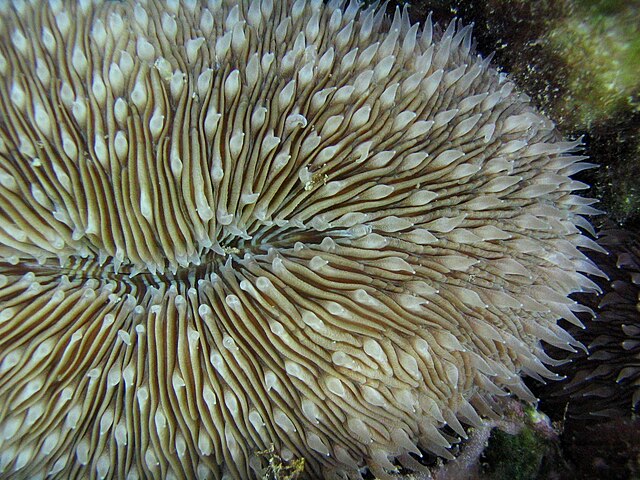
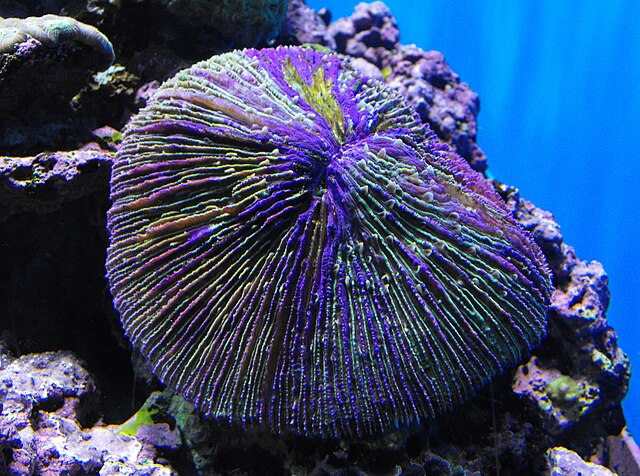
Fungia, by contrast, are true stony corals (Scleractinia) possessing a calcareous skeleton. Many species detach from their base as they grow and live as solitary corals on sandy substrates. Viewed from above, their radial septa spread concentrically, and their mushroom-like form is why English-speaking aquarists call them "mushroom corals."
Although Corallimorpharia and Fungia share a visual resemblance, the key differences in care—the presence or absence of a skeleton, their taxonomic lineage, and their ecology of free-living on sandy substrates—are substantial. For Fungia, the fundamentals are placement that prevents burial in sand, avoidance of strong direct current, and ensuring ample space for the individual to move freely.
Care Guidelines for Corallimorpharia-Type Mushroom Corals
Corallimorpharia are generally hardy, with most species disliking strong lighting and strong water flow. Here are the key points for their care:
- Start with moderate lighting, not too intense (many individuals shrivel under direct, intense light)
- Keep water flow to gentle swaying; avoid continuous direct current
- Attach them to rock crevices or flat surfaces, ensuring space for lateral growth
- They tolerate environments with moderate nutrient levels relatively well and are easy to introduce into newly established tanks
Due to their ease of care, Corallimorpharia are often recommended alongside Star Polyps and Zoanthids as gateway soft corals for beginners.
Propagation and Ecology from a Natural History Perspective
Corallimorpharia can be propagated by excising portions of tissue including part of the oral disc, yielding multiple clones with the same pattern and coloration as the parent. The basic approach is to attach excised tissue fragments to rock or skeleton pieces and allow them to recover in a low-flow area; over time they will develop into independent individuals.
In nature, they typically form dense aggregations in reef flat and reef edge environments with high variability in light and flow, and solitary specimens are rare. This colonial tendency is evident in the aquarium as well; under suitable conditions they gradually proliferate and cover rock surfaces.
When stressed, they may remain retracted and fail to open, or the oral disc may appear split; causes vary from rapid water chemistry changes to contact with neighboring individuals. If abnormalities persist, consult a specialty shop or experienced aquarist before self-treating with medications. Because Corallimorpharia are vigorous propagators, in small tanks they can overgrow adjacent specimens—regular layout review and thinning out overgrown areas through fragmentation are effective long-term management strategies.
Both Corallimorpharia and Fungia are captivating corals called "mushroom," but understanding that they are two separate groups first makes information from reference guides and shops much easier to grasp. Rather than judging by name alone, keeping in mind the differences in skeleton presence and placement methods, and providing each with a care environment suited to its ecology, is the shortcut to enjoying healthy specimens for years.