Why Do Coral Scientific Names Change? | A Classification Revision from Euphyllia to Fimbriaphyllia
As molecular phylogenetic analysis advances, coral classifications are sometimes revised. Using the example of how some Euphyllia species were reclassified as Fimbriaphyllia, we explore how scientific names change and offer practical guidance for purchasing and recording specimens.
Key Takeaways
As molecular phylogenetic analysis advances, coral classifications are sometimes revised. Using the example of how some Euphyllia species were reclassified as Fimbriaphyllia, we explore how scientific names change and offer practical guidance for purchasing and recording specimens.
Have you ever felt confused when comparing online retailers or field guides and noticed that the same-looking coral has different scientific names? In fact, coral classification is not fixed — it evolves as research advances. This article explains why coral scientific names can change, using the example of how part of the genus Euphyllia was reclassified into the genus Fimbriaphyllia.
Why Do Scientific Names Change?
Coral classification has long been based on external features such as skeletal structure and polyp morphology. However, in recent years, molecular phylogenetic analysis — comparing DNA sequences — has become widely used, revealing evolutionary relationships between species that were not visible from appearance alone.
- When classification relies only on morphological features, corals that look similar may actually belong to different evolutionary lineages, and conversely, those that look different may be closely related
- Molecular phylogenetic analysis often reveals that a single genus contains multiple distinct lineages mixed together
- When this non-monophyletic state is demonstrated, genera or subgenera are revised and reorganized to correct the classification
Such revisions are not uncommon and occur across all biological classification, not just corals. Because there are delays in when reference materials update, both old and new scientific names can coexist for the same species.
The Reclassification of Euphyllia
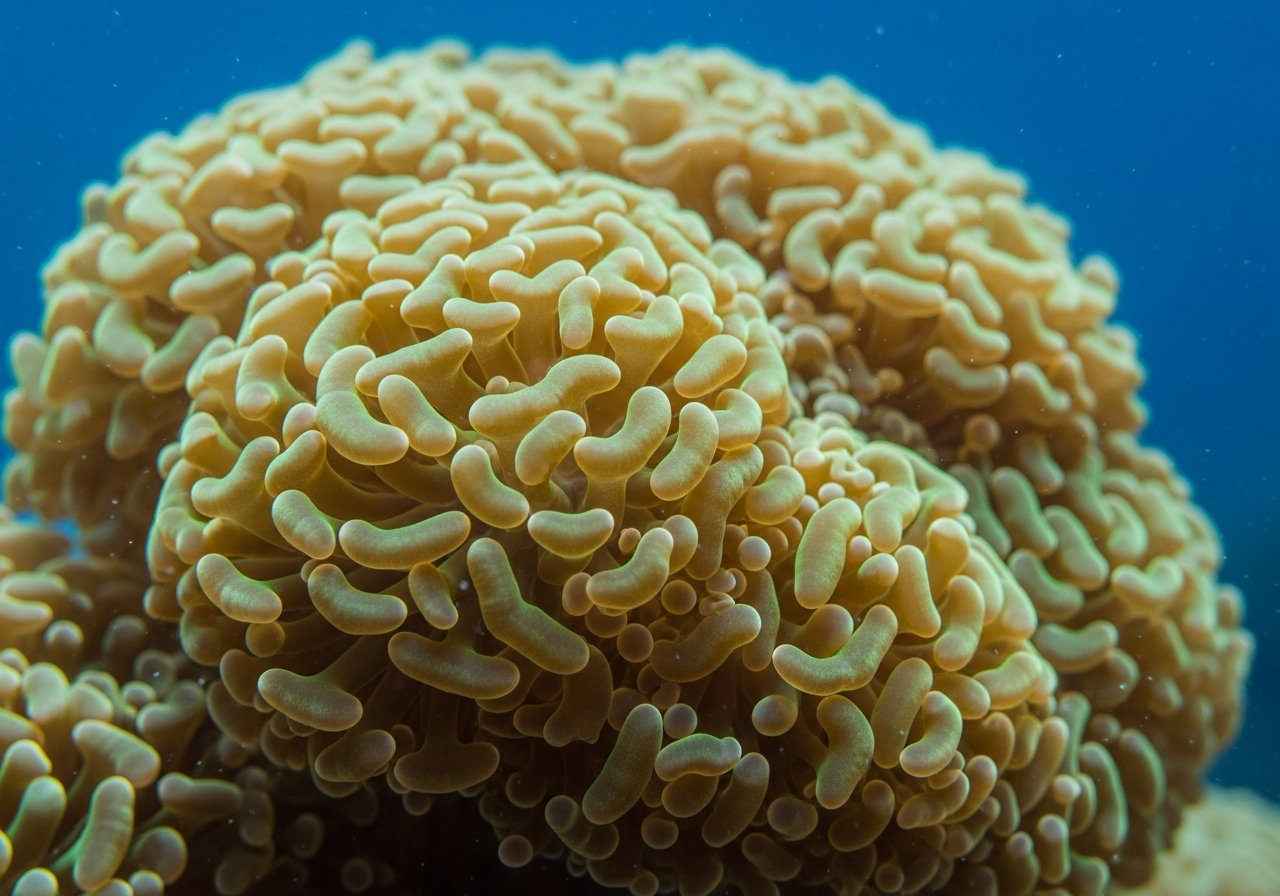
As a concrete example, consider the revision of the genus Euphyllia. In 2017, a molecular phylogenetic study (published in PeerJ by Luzon et al.) examined the phylogenetic relationships of multiple species in Euphyllia using the mitochondrial DNA genes cox1 and cytb, along with the nuclear β-tubulin gene.
The results showed that Euphyllia glabrescens formed an independent lineage, while Euphyllia ancora, E. divisa, E. paraancora, E. paradivisa, and E. yaeyamaensis formed a closely related group that was more closely related to Galaxea fascicularis — a different genus in the same family. In other words, what had previously been treated as a single genus Euphyllia actually contained multiple lineages of different origins.
In response to these findings, the research team proposed reviving Fimbriaphyllia — originally proposed as a subgenus of Euphyllia by Veron and Pichon in 1980 — as an independent genus. Euphyllia ancora, E. divisa, E. paraancora, E. paradivisa, and E. yaeyamaensis were transferred to the genus Fimbriaphyllia, while Euphyllia glabrescens remained in the genus Euphyllia. This reclassification is reflected in the World Register of Marine Species (WoRMS), where Fimbriaphyllia is now registered as an accepted genus.
Why Old and New Scientific Names Coexist in Retailers and Guides
Even when such classification revisions occur, the trade names used by retailers and aquarists do not immediately change. Scientific name changes are academic reorganizations; the actual individual coral remains unchanged.
- Academic databases update to reflect new classifications relatively quickly
- Retail websites, personal blogs, and older field guides may retain old names depending on their update schedules
- The same individual or species may be referred to by either Euphyllia or Fimbriaphyllia names depending on the source consulted
Therefore, seeing old scientific names on retail sites does not necessarily mean they are incorrect. It is helpful to read such information with the understanding that the terminology may predate the circulation of taxonomy update information.
Practical Perspectives for Purchase and Record-Keeping
From the aquarist's perspective, what matters more than the change in scientific name itself is understanding which species a given reference is actually describing.
- When purchasing, recording not just the trade name but the scientific name as well — if available — makes it easier to track down information later
- When maintaining specimen records, noting the scientific name used at the time of purchase, along with a memo if the classification has since been updated, helps preserve the specimen's history
- When uncertain about scientific name differences, consulting academic databases like WoRMS to confirm the current classification is most reliable
For an overview of the relationship between coral scientific names, trade names, and classification, see How to Read a Coral Guide and Understand Lineage. For information on keeping Euphyllia species themselves, see Keeping Euphyllia | Care and Propagation of Hammers, Torches, and Frogspawns, and for the guide page on relevant species, see Euphyllia group (Hammers, Torches).
Summary
Coral scientific names continue to be revised as molecular phylogenetic analysis advances. As exemplified by the reclassification of part of the genus Euphyllia into Fimbriaphyllia, evolutionary relationships that were difficult to discern from appearance become clarified through DNA analysis, leading to classification updates. When old and new scientific names coexist in retailers or guides, understanding that in most cases both refer to the same species will help you interpret the information more effectively.