Acropora (ミドリイシ) Care Fundamentals: The Three Pillars of Light, Flow, and Water Quality
Master the essentials of Acropora care through the three pillars of light, water flow, and water quality. This guide covers the baseline parameters to succeed with SPS for the first time and tips for observing your corals to prevent bleaching.

Key Takeaways
Master the essentials of Acropora care through the three pillars of light, water flow, and water quality. This guide covers the baseline parameters to succeed with SPS for the first time and tips for observing your corals to prevent bleaching.
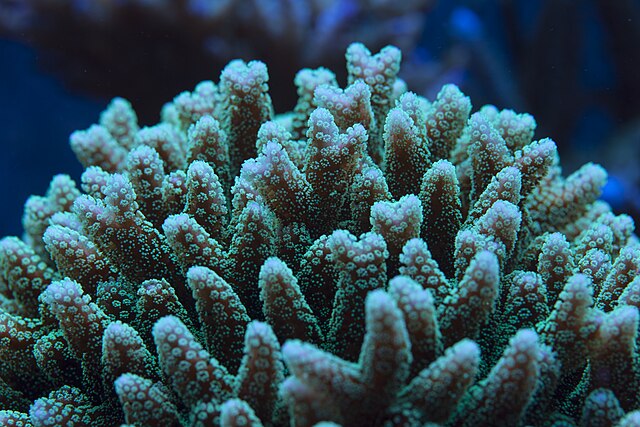
Acropora is the flagship SPS (Small Polyp Stony) coral, prized for its spreading branches and vibrant fluorescent coloration. Many aquarists aspire to a reef tank featuring these corals as the ultimate goal, yet they are sensitive to water parameter swings—resulting in the common failure of unexpected bleaching. The key to keeping them healthy lies in stabilizing the three pillars: light, water flow, and water quality. This article lays out the baseline parameters and observational approach for those attempting Acropora for the first time. Success in long-term maintenance depends not on setting these factors once and forgetting them, but on developing a habit of noticing small daily changes.
Light: Prioritize Stability and Spectrum Over Raw Intensity
Acropora depends on energy produced by its symbiotic zooxanthellae through photosynthesis. A workable range is roughly 200–350 PAR (photosynthetic photon flux density); exposing them immediately to intense light causes the zooxanthellae to bleach out. When introducing a new colony, place it low in the tank and move it upward gradually over several weeks—a process called "light acclimation." Blue wavelengths enhance fluorescence, but resisting the temptation to increase intensity for color enhancement is key to long-term success. The actual light reaching the coral varies depending on fixture type, installation environment, surface refraction, glass clarity, and distance from the light source. Treat measured PAR values as guidelines rather than absolutes, and fine-tune by observing polyp extension and color changes in real time.
Water Flow: Create Movement Without Stagnation, Keep Polyps Gently Moving
In nature, Acropora faces strong wave action on the reef. In the tank, apply strong, random flow to prevent detritus and waste from accumulating in branch crevices. The goal is gentle polyp movement—forceful enough to keep the coral clean but not so strong that sand is stirred up and tissues are damaged. Position multiple pumps to face each other, creating flow variation over time to eliminate dead spots. Avoid leaving pump orientation and strength fixed; periodically review and adjust your flow arrangement. Continuous strong flow in one location causes tissue wear on that spot, while the opposite side may become stagnant and accumulate debris. Using pumps with random modes or alternating multiple pumps is an effective way to create flow variation and maintain healthy branch structure.
Water Quality: Low Nutrient Load and Stable Carbonate Hardness
Acropora thrives in nutrient-poor conditions with low nitrate and phosphate. A workable range is approximately 1–5 mg/L nitrate and 0.02–0.08 mg/L phosphate. However, chasing zero levels starves the zooxanthellae, causing color loss; maintaining trace amounts is intentional. Carbonate hardness (KH) is critical for skeletal formation. Maintaining 7–9 dKH with daily fluctuations within ±0.5 balances color and growth. Regular testing with quality test kits prevents sudden parameter swings—the most important safeguard. Water quality management does not end after one adjustment; keeping records of water changes and supplement dosing, then tracking trends, is essential.
Balancing Trace Elements: Calcium, Magnesium, and More
Beyond KH, calcium, magnesium, and other trace elements are indispensable for Acropora growth. These elements interact with one another; supplementing only one at the expense of others yields diminishing returns. When using supplements, begin by testing current levels, then adjust gradually in small increments while observing results. Avoid sudden parameter changes; adjust gently over time. This measured approach prevents imbalance and maintains the conditions these corals demand.
Don't Miss the Signs of Bleaching and RTN
Color loss at the tips and tissue recession from the base are stress warnings. Rapid Tissue Necrosis (RTN) can destroy an entire colony in hours. Sudden water parameter shifts, KH swings, or lighting failures often trigger it. If you notice trouble, isolate the affected colony and methodically address each potential cause. Observing polyp extension daily is your best early-warning system. Bleaching does not always mean immediate death; removing the stressor and stabilizing the environment can allow zooxanthellae to return and the coral to recover. Recovery takes time, so early detection and intervention are critical. Develop a habit of examining not just the overall tank but also the color and branch tips of individual colonies; this habit catches subtle problems early.
Care During the First Week: A Gentle Hand
When you first bring home a colony, acclimate it carefully, dip it in coral-safe solution to remove pests if needed, then place it in the lower part of the tank. During the first week, resist the urge to move or adjust it—let the polyps open and the colony acclimate. Honoring this hands-off period makes a dramatic difference in settlement and subsequent growth. Pay attention to spacing between colonies as well. Fast-growing corals touching neighbors trigger chemical warfare between them; ensure adequate spacing to prevent interference.
Fragging and Colony Division: Basic Principles
A well-established colony can be fragmented—cutting branches to propagate new specimens. Fragging not only multiplies your collection but also spreads risk if the parent colony encounters problems. However, freshly cut branches are more delicate than the parent. Place fragments in areas with calm flow and lower light intensity for a recovery period before moving them to standard conditions. This staged approach reduces failure.
Record-Keeping as Part of Aquaculture
Light, flow, and water quality succeed through accumulated small daily changes. Logging feeding, supplement dosing, water change timing, polyp behavior, and color shifts helps you understand later which factors drove success or decline. Moving beyond intuition and using records to understand your tank's specific quirks builds long-term stability.
Acropora husbandry is often portrayed as difficult, but it ultimately boils down to "building stability and avoiding sudden changes." Mindfully managing the three pillars alongside trace element balance and consistent record-keeping will reward you with thriving branches filling your reef. Take your time, work at your tank's pace, and enjoy the journey.