Montipora Morphological Classification and Rearing Environment | Understanding the Differences from Acropora
As a representative SPS species, Montipora exhibits diverse growth forms that differ from Acropora, another SPS type. This article explains the characteristics of each form—digitate, plate, and encrusting—and how to optimize light, water flow, and nutrient environments for each.
Key Takeaways
As a representative SPS species, Montipora exhibits diverse growth forms that differ from Acropora, another SPS type. This article explains the characteristics of each form—digitate, plate, and encrusting—and how to optimize light, water flow, and nutrient environments for each.
Montipora and Acropora: Making the Distinction
SPS (Small Polyp Stony) corals are represented by Acropora, which is well-known among hobbyists, but Montipora is also a popular hard-skeleton coral. Although both fall under the SPS category, they differ significantly in both taxonomic classification and husbandry requirements.
Acropora typically exhibits linear branching growth with relatively uniform polyp placement throughout. In contrast, Montipora is characterized by morphological diversity, with different colonies forming entirely distinct silhouettes. This morphological variability is what makes Montipora husbandry more nuanced and rewarding.
Major Morphological Classifications of Montipora
Digitate Form (Digitate)
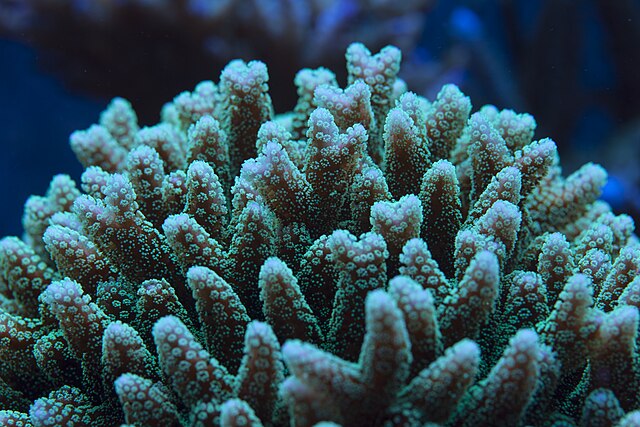
Digitate forms feature thick, finger-like branches radiating from the base. Since growth points are concentrated at the branch tips, growth rate is slower than Acropora, yet this form remains popular for its striking visual presence. Representative species include Montipora digitata, which comes in various color morphs such as blue and green.
In this form, polyps are evenly distributed across the entire branch, allowing efficient feeding from the sides. For rearing, moderate light intensity (PAR 150–250) promotes healthy growth; excessive light can actually cause bleaching. Water flow should be bidirectional and gentle to moderate—strong currents are unnecessary.
Plate Form (Plate/Encrusting)
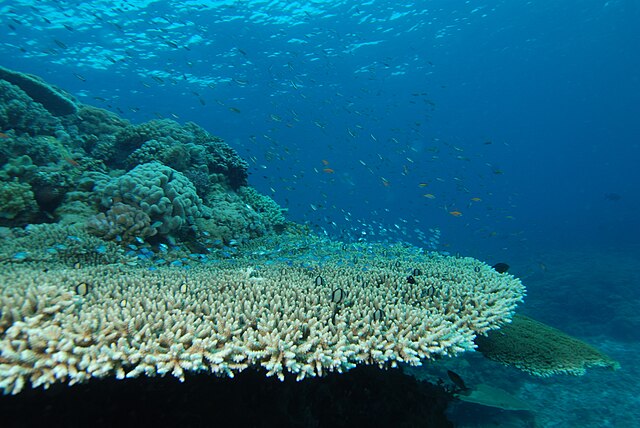
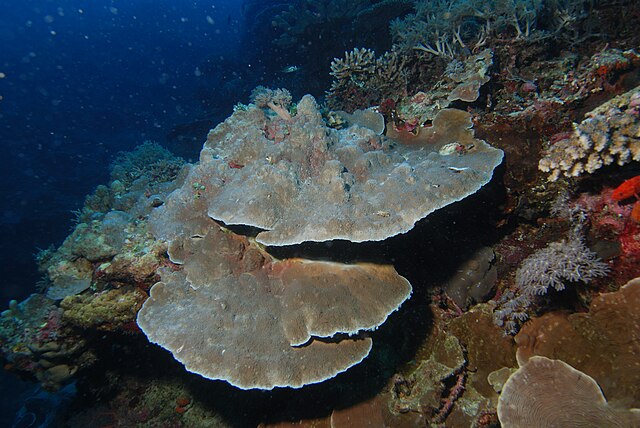
Plate forms grow flat and adhere tightly to rock or substrate surfaces, spreading radially with slightly raised edges. These corals grow rapidly, and with adequate space, expansion is swift enough that many hobbyists eventually feel they're spreading too quickly.
An advantage of plate forms is their strong adhesion to stone, making fragment collection straightforward and propagation efficient. These corals are relatively light-tolerant and can thrive at PAR 100–200. However, consistent water flow is essential—stagnant areas result in sluggish growth and poor polyp extension.
Light Environment: Comparison with Acropora
While Acropora prefers high light intensity (PAR 250+), most Montipora species thrive under moderate light. In practice, bleaching from excessive light is reported far more frequently than deficiency from insufficient light.
Dark-colored digitate forms—particularly blue, green, and red morphs—require gradual light acclimation upon introduction. Initially place the coral around PAR 100, then increase light gradually over several weeks to prevent color loss. Individuals rich in fluorescent proteins tend to be especially light-responsive.
Water Flow and Nutrient Environment
Montipora does not require the intense water flow that Acropora demands. Instead, calm bidirectional flow is ideal. Strong unidirectional currents (sustained 1000+ LPH) cause polyp retraction and inhibit feeding and photosynthesis.
Within the tank, position the coral where it receives gentle, diffused flow rather than direct discharge from the return pump. Simultaneously, avoid completely stagnant areas. Regarding nutrient salts (nitrate and phosphate), Montipora tends to prefer slightly higher concentrations than Acropora.
Frag Production and Attachment
Creating Montipora frags is often easier than with Acropora. Plate and encrusting forms can be cut with nippers or a drill and secured to new substrate with adhesive, attaching readily. Even digitate forms, when cut at the branch base and affixed with cyanoacrylate, develop new skeleton within weeks and establish firm attachment.
For successful initial attachment, place frags in areas receiving slightly less light and flow than the mother colony. Minimizing stress from excessive light prevents decay and bleaching.
Growth Rate and Management Tips
Montipora growth rate varies significantly by individual colony and environment. Digitate forms typically expand 1–2 cm per month, while plate forms expand 2–3 cm monthly. With abundant nutrients and appropriate lighting, acceleration to 3–4 cm per month is achievable.
To manage excessive growth, regularly (every 3–6 months) remove frags or trim growth areas with nippers. Since Montipora exhibits minimal allelopathic aggression toward neighboring corals, placement adjacent to other species is straightforward—another attraction of keeping Montipora.
In Conclusion: Appreciating Diversity
Montipora's primary appeal lies in its morphological diversity. Even within the same species name, color, growth form, and polyp size often vary between individual colonies. This individual variation is the essence of Montipora husbandry—discovering specimens suited to your tank environment and realizing their full potential. By understanding the ecological traits that distinguish Montipora from Acropora and fine-tuning conditions to suit each coral's specific needs, far richer coral husbandry becomes possible.